Taking a hint from notcoming.com (one of my regular sites of attraction), for the upcoming month of October I'll be - at least theoretically - running something of a horror film marathon. My reasons for this are multiple. Part of me wants to see just how rigorous I can be with film watching, reviewing, analyzing and writing, and, paired with academic work, employment, familial concerns and the upkeeping of a relationship (all of which are substantial), this will be some sort of ultimate test as to my ability to manage my time and retain some composure and sanity under the conditions. Watching movies can be very hard work. Secondly, I simply love the horror genre, it being one of the formulative cinematic elements of my youth that has continued to grow over the years.
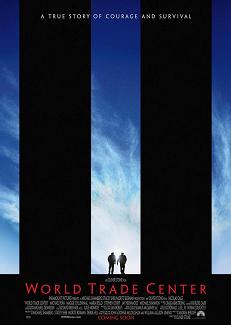
World Trade Center’s script is so bourgeois and reductive that one might mistake it for the latest output from Paul Haggis. Still, just as Clint Eastwood took a flawed script and nurtured it into a near-masterpiece with Million Dollar Baby, that fact only makes what Oliver Stone and his superlative cast managed here all the more impressive. It’s hard to imagine what, subject matter aside, attracted Stone to this particular script, which packages the events of September 11th so tidily as to render many real-life occurrences as potential Hollywood inventions, but it’s also reassuring to see them rendered as respectfully as they are. What was but inches away from a practical remake of The Towering Inferno is thankfully the ruminative work it was meant to be, even if it is a bit dodgy along the way.


Aguirre, the Wrath of God opens with a lightly image whose potency steadily accrues as the sheer scope of it all sets in: a band of humans slowly descending the steep terrain of a fog-shrouded mountainside, so miniscule amongst the landscape that they appear not unlike a line of ants. So too does the entire film feel the impossible weight of the natural world bearing down upon the fragility of mankind, who dares to suggest that he can conquer it and claim it as his own. Less of a criticism of imperialism than a somber, hypnotic mood piece that absorbs, digests, and regurgitates the vanity of mankind’s conquering spirit, Aguirre creeps into the psyche like an anesthetic through an IV tube. It may be the most hauntingly ethereal film even made.


WASHINGTON, Sept. 23 — A stark assessment of terrorism trends by American intelligence agencies has found that the American invasion and occupation of Iraq has helped spawn a new generation of Islamic radicalism and that the overall terrorist threat has grown since the Sept. 11 attacks.
The classified National Intelligence Estimate attributes a more direct role to the Iraq war in fueling radicalism than that presented either in recent White House documents or in a report released Wednesday by the House Intelligence Committee, according to several officials in Washington involved in preparing the assessment or who have read the final document.
The intelligence estimate, completed in April, is the first formal appraisal of global terrorism by United States intelligence agencies since the Iraq war began, and represents a consensus view of the 16 disparate spy services inside government. Titled “Trends in Global Terrorism: Implications for the United States,’’ it asserts that Islamic radicalism, rather than being in retreat, has metastasized and spread across the globe.
An opening section of the report, “Indicators of the Spread of the Global Jihadist Movement,” cites the Iraq war as a reason for the diffusion of jihad ideology.
The report “says that the Iraq war has made the overall terrorism problem worse,” said one American intelligence official.
The Lake House employs a bourgeois narrative with a ripe sense of spirituality that borders on divine. For all its polished hoopla and handy-dandy supporting characters, thank director Alejandro Agresti for recognizing (and capitalizing on) the emotional power of a fine visual composition (not to mention his respect for his characters, who live and breath as part of the film rather than being whored out by the script). The titular architectural structure is a unique residence elevated above its shoreline domain on stilt-like appendages, build within and around its natural habitat (not unlike many Frank Lloyd Wright structures) rather than simply on top of it. It is here that Kate (Sandra Bullock) and Alex (Keanu Reeves) live, albeit two years apart, she in 2006 and he in 2004. When Kate moves out and leaves a note for the subsequent tenant in the mailbox, the two discover an inexplicable time portal, the post office’s property somehow existing outside of the timelines that otherwise guide their physical worlds. Subsequent letters sent back and forth through the newfound device instill an otherwise impossible relationship, compounded by the eventual realization of their own previous encounter(s). Certainly, the science fiction device makes little sense, but neither did it in Back to the Future, The Terminator or 12 Monkeys if you really think about it (at least when conforming to known physics), and for as easily as the premise could have slid into outright treacle, that alone makes The Lake House its own little miracle (it is worth noting, however, that this is a remake of a little known foreign film, as of now unseen by me). Aside from uncompounded character evocations, the most effective device here is the camera itself, constantly evoking a spiritual connection between the characters and their environments. Once established, the film takes full advantage of Alex and Kate’s time-defying intimacy, one magical sequence seeing them talking to each other on two separate park benches, passerby fading into and out of the composition, suggesting the intangibility of time, the fragility of prolonged existence and the wonder that any kind of love could ever arise out of such conditions.


"Why do you hate America?" This is a remarkably easy question to provoke. One might, for instance, expose elements of this nation's brutal foreign policy. Ask a single probing question about, say, U.S. complicity in the overthrow of governments in Guatemala, Iran, or Chile and thin-skinned patriots (sic) will come out of the woodwork to defend their country's honor by accusing you of being "anti-American." Of course, this allegation might lead me to ponder how totalitarian a culture this must be to even entertain such a concept, but I'd rather employ the vaunted Arundhati defense. The incomparable Ms. Roy says: "What does the term 'anti-American' mean? Does it mean you are anti-jazz or that you're opposed to freedom of speech? That you don't delight in Toni Morrison or John Updike? That you have a quarrel with giant sequoias?" (I'm a tree hugger remember? I don't argue with sequoias.)
When pressed, I sometimes reply: "I don't hate America. In fact, think it's one of the best countries anyone ever stole." But, after the laughter dies down, I have a confession to make: If by "America" they mean the elected/appointed officials and the corporations that own them, well, I guess I do hate that America-with justification.
Among many reasons, I hate America for the near-extermination and subsequent oppression of its indigenous population. I hate it for its role in the African slave trade and for dropping atomic bombs of civilians. I hate its control of institutions like the United Nations, World Bank, International Monetary Fund, and World Trade Organization. I hate it for propping up brutal dictators like Suharto, Pinochet, Duvalier, Hussein, Marcos, and the Shah of Iran. I hate America for its unconditional support for Israel. I hate its bogus two-party system, its one-size-fits-all culture, and its income gap. I could go on for pages but I'll sum up with this: I hate America for being a hypocritical white supremacist capitalist patriarchy.
After a paragraph like that, you know what comes next: If you hate America so much, why don't you leave? Leave America? That would potentially put me on the other end of U.S. foreign policy. No thanks.
I like how Paul Robeson answered that question before the House Un-American Activities Committee in 1956: "My father was a slave and my people died to build this country, and I'm going to stay right here and have a part of it, just like you. And no fascist-minded people like you will drive me from it.
Is that clear?"
Since none of my people died to build anything, I rely instead on William Blum, who declares, "I'm committed to fighting U.S. foreign policy, the greatest threat to peace and happiness in the world, and being in the United States I the best place for carrying out the battle. This is the belly of the beast, and I try to be an ulcer inside of it."
Needless to say, none of the above does a damn thing to placate the yellow ribbon crowd. It seems what offends flag-wavers most is when someone like me makes use of the freedom they claim to adore. According to their twisted logic, I am ungrateful for my liberty if I have the audacity to exercise it. If I make the choice to not salute the flag during the seventh inning stretch at Yankee Stadium, somehow I'm not worthy of having the freedom to make the choice to not salute the flag during the seventh inning stretch at Yankee Stadium. These so-called patriots not only claim to celebrate freedom while refusing my right to exploit it, they also ignore the social movements that fought for and won such freedoms.
There's plenty of tolerated public outcry against the Bush administration and the occupation of Iraq, but it's neither fashionable nor acceptable to go as far as saying, no, I do not support the troops and yes, I hate what America does. Fear of recrimination allows the status quo to control the terms of debate. Until we voice what is in our hearts and have the nerve to admit what we hate...we will never create something that can be loved.
The Black Dahlia is sure to baffle and bewilder audiences everywhere on both sides of the spectrum (that is, to say, in ways perceived as both good and bad), and I’m sure Brian De Palma wouldn’t have it any other way. An adaptation of a fictionalized novel about a real-life Hollywood murder, the film has been shamefully marketed by industry whores as the next L.A. Confidential, and all I can say is it’s damn shame. The ilk of this film is nothing of the sort, genre overlap notwithstanding, and it’s hard to blame viewers expecting a more straightforward crime drama when they enter theaters. Instead, The Black Dahlia is a rampantly overwrought round of genre upheaval, equally indebted to its cinematic predecessors as it is to its director’s wonderfully obtuse visual sleight of hand. “Cocktail” is the only word that comes to mind when attempting to describe the mixture of classic noir and mystery elements with deliberate overdoses of campy magnification. The film harkens back to classic expressionism via its three main characters’ attendance at a screening of The Man Who Laughs, fitting, for like that film’s main character (a deformed carnival worker whose face is forever frozen in an eerie grin), The Black Dahlia is a film largely concerned with the nature of surface appearances, reveling in its self-imposed limitations within a world of pure cinema. The cast is almost equally excellent across the board (particularly Scarlett Johansson, who hits the archetype nail most directly on the head), although many will mistake their intentional embodiment of caricatures as flat-out wooden acting. It’s necessary to approach The Black Dahlia with these expectations if one is to experience the film on its own merits, but this is not all to say the film is without its downfalls. Visually, this is one of Brian De Palma’s most refined films yet (his swooping camera motions are both grand in scope and smooth in execution), yet his sense of reckless abandon seems to lose its track during the final act with a considerable drop in energy following suit. Perhaps the source material demanded this unfortunate muting, but either way, one can’t but think The Black Dahlia could have gone out with at least as strong of a bang as it starts.


Since this is my first “second” review on this blog, let me nip any potential criticisms in the bud this one time only (any future complaints will be pointed in this direction). My philosophy, unlike that of Pauline Kael, is that repeated viewings are as important – sometimes even more so – to appreciating a film than the initial experience. Of course, many of us watch movies more than once all the time, whether for a fun time with friends, to revisit a treasured experience, or, in my case from time to time, to clarify my thoughts on a difficult and unclear initial experience. Some films challenge our perspectives so much that a combination of hindsight and intense rumination is necessary in order to come to a firm conclusion on them, and I don’t like for any of my opinions to be something I am forced to “settle” on. Therefore, in any cases where a repeated viewing of a particular film yields a changed opinion on my part, a second review will be written; this will become my “official” coverage, but the original review will remain listed as a reference point. This site exists just as much for hosting my opinions as it does for tracking my grappling with the medium.


September 15th, 2006
Q: Thank you, Mr. President. Earlier this week, you told a group of journalists that you thought the idea of sending special forces to Pakistan to hunt down bin Laden was a strategy that would not work…recently you’ve also described bin Laden as a sort of modern day Hitler or Mussolini. And I’m wondering why, if you can explain why you think it’s a bad idea to send more resources to hunt down bin Laden, wherever he is?
The President: Pakistan is a sovereign nation. In order for us to send thousands of troops into a sovereign nation, we’ve got to be invited by the government of Pakistan.
2004 State of the Union Address
The President: America will never seek a permission slip to defend the security of our country.
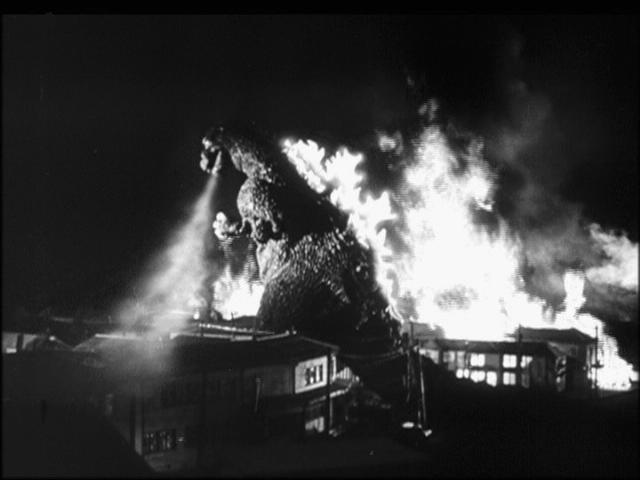
Greatness in film often derives less from manifest perfection than it does more debatable flaws. Perfection suggests rigid structure, a quality most in opposition to the exploratory nature of art (although not necessarily in opposition to cinema’s potency as a storytelling medium), and artistic approaches that instill unease or discomfort (or even revilement) on one hand are often the most aesthetically charged and cause for celebration on the other. This kind of introduction would, admittedly, be more appropriate for one of the medium’s many “flawed” masterpieces; Apocalypse Now and Gangs of New York come to mind. Yet in the case of Ishirô Honda’s original Godzilla (to be referred to as its native Gojira hereafter) – a serious examination on the effects of nuclear war that has since become clouded by endless, cheesy sequels, rip-offs, and remakes – there is a definite case of cinematic split personality that should at least be examined before being accepted or rejected. Is it a bad movie? Technically speaking, yes, but movies are much more than just a technical exercise, and to suggest otherwise is to blaspheme. Yet the tagline “The Original Japanese Masterpiece,” printed on the newly released DVD set, is equally misleading.


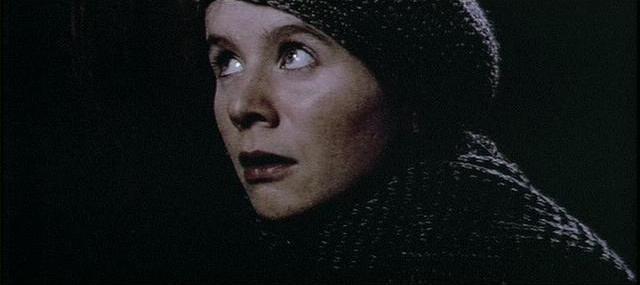
My chief concern with this review is that it might fail in giving the movie in question enough credit, so let me abandon any sense of subtlety for a moment and lay it out in simple terms: Lars Von Trier's Breaking the Waves is the best film I have yet seen from the 1990’s. Influenced by – but not in complete accordance with the rules of – the Dogme 95 cinematic movement co-founded by von Trier himself, the film takes a relatively simple story and reinvigorates its potential by stripping its technical qualities down to the bare, earthly elements. We’ve seen this sort of tale before, from Hollywood classics to Oscar-tailored hackwork to Lifetime movies of the week, but never with as much pulsing life force as exhibited here. Of course, one could hotly debate that Emily Watson is the chief reason for the films’ success (I’m more of a parts-to-the-whole onlooker than one who singles out specific elements), her performance as the naïve but loving and faithful Bess McNeill one of magnificent range and staggering emotional potential. No offense, Francis, but you can’t hold a candle.


To me it’s impossible to separate 9/11 from Hurricane Katrina. For four years we’d been promised that the leadership of George Bush and the Republican party could keep us safe, yet the aftermath of a natural disaster showed us that the federal government can’t even protect us from a threat they have a week to prepare for. How could we expect them to respond to a dirty bomb attack, on electromagnetic pulse, a nuclear bomb smuggled in a shipping container, another anthrax attack, a few trucks filled with fertilizer explosives surrounding a sports arena, or more airliners hijacked with terrorists using ceramic or plastic blades and crashing them into chemical plants, the New York Stock Exchange, or the Capitol building during the State of the Union?
So, where does that leave us? Well, the presidential administration we’re stuck with for the next two years is a deadly combination of arrogance, stubbornness, and being-wrong-about-everything-ness. But it is an election year (which you may have guessed from the President’s suddenly sparked interest in Osama Bin Laden), so there’s still an opportunity to change course.
So on this fifth anniversary of the worst day of my life, I’m tired of watching the country be crippled by its grief and fear. We’re in danger, things aren’t getting better, and we need to keep asking the same goddamn questions until we get answers. Who’s keeping us safe? Well, I know who isn’t.
What can be said, really, that hasn’t been yet? Only five years have passed, but my guess is there are few people out there who can honestly say they haven’t been of an epic stretch. Reactions, of course, have been wildly different, and almost too much so. We now live in a black and white world, when such a destructive event should have unified us. Everything is now us versus them, left and right, democrat and republican, and no one wants to look further to distinguish the grey areas between absolute right and wrong.
This attitude has, unfortunately, encompassed the rest of the world, to an extent. Some fellow countries and their populations have insensitively insinuated that we need to “get over” the attacks, a statement triggered by our leaders’ despicable manipulation of the events to drive and justify their political aims, but one that forgets the deep emotional wounds that need to be healed. The United States has not (nor has it ever) been the ultimate purveyor of good this past half-decade, but looking at how deeply divided our ideas are of late will tell you how committed many of us are to bringing about a sense of good in the world (even if many of us are, one way or another, misguided in out attempts). We’re not “the greatest country in the world,” and nor is any one in particular. The last time I checked, the earth was round, and all efforts should be communal, not self-servicing, as they too often prove to be. We’ve certainly strayed off that track lately through our zealous nationalism and irrational, impatient approach to protecting ourselves. In defending our own soil, we’ve created fertile ground elsewhere to breed more of the hateful ideas that hurt us in the first place.
The introspection brought about by the attacks and their political aftermath is one that I doubt will ever go away, at least in my lifetime or as regards myself personally. I can’t speak for everyone. I do know, however, in regard to the person I am now as opposed to the person I was before
I’m almost ashamed to only be writing this today. Certainly, I’ve written about this and many other related aspects of the whole misbegotten situation many days before, but to relegate it only to the dreadful anniversary seems an act of cowardice. We must carry these memories with us every day, but rather than dwelling on them, we must move on and make the best use of them in the future. I fear that we’re yet far from doing so, and that one tragedy will only lead to another. Only time will tell, but we are not fruitless in our actions. Now, more than ever, apathy is the greatest enemy we have to face. I can only hope we choose to avoid its stranglehold.
Despite the departure of Nicole Kidman and James Caan (and the subsequent replacement by Bryce Dallas Howard and Willem Dafoe) and the passage of several years since Dogville, Manderlay continues the same path without missing a beat, although it begs the question of whether this slightly different material merited the same minimalist style as its predecessor. Surely a trilogy (to be concluded with Wasington - that's right, no "h") that largely concerns itself with the superficiality of appearances wouldn’t itself need to conform to a continuous thread of visual similarity, but perhaps this is less a case of misused devices than it is merely an acknowledgment of how exceedingly well Dogville employed the same challenging approach. Grace (now played by a red-haired Howard) and her father’s roving gangsters have just left (after having obliterated) Dogville, and, traveling through the heartland of America, happen upon an enclosed plantation where, over seventy years after the abolition of slavery, the practice is still very much in full swing. Her guilty liberal attitude in full upswing, Grace uses her familial power to correct these discovered ills, although it quickly becomes apparent that, her best intentions notwithstanding, she isn’t entirely able to convert these sheltered negroes into equal, democratic citizens; habit and ingrained mentalities initially caused by enslavement linger long after freedom has been bestowed. In this regard, Manderlay outdoes almost any recent effort of late when it comes to deconstructing racial relations in America (I’m talking to you, Crash), even if it does so on a relatively specific historical level. The artificial aesthetic of the film is less overtly handled this time around (if I recall, only once did a character mime knocking on an invisible door), but nor do its events conclude with the same wrenching aplomb, all in all making for a slightly more ponderous – if less dramatically satisfying – example of a Von Trier puppet show.


Quality notwithstanding, the marketing campaign for The Break-Up - which cast the film as something of a follow-up to lead Vince Vaughn’s comedic mega-hit Wedding Crashers - is one of the more heinous recent moves on the part of the entertainment industry. Still, the Scenes from a Marriage reminiscent poster, culling the same imagery of a couple upright in bed, is quite appropriate in projecting the film’s general tonalities. A generally dark examination of the end of a relationship which, were it not for a mixture of embarrassingly slapdash comedic elements possibly edited in after test audiences demanded more humor, might have been able to hold a minute candle to Bergman’s masterpiece, The Break-Up suffers from an inappropriate adherence to Hollywood convention even when the script screams for otherwise. Vaughn and Aniston are Gary and Brooke, whose long-term union suddenly reaches a breaking point: his obsession with videogames and her workaholic attitude finding no similar grounds on which to unify. The film finds effective expressions of separation and internal conflict by means of the architectural placement within their condo unit, but the dialogue (which makes up most of the films’ backbone) generally fails to probe amply beneath the surface, dealing more in generalities than exploring the intimate details of these characters. There’s more to love than hate here, but even its high-aimed but low-fueled intentions are thrown horribly askew by the reliance on overtly homosexual and needlessly weird supporting characters for inconsistent laughs, seemingly meant to break the otherwise overriding tension.


The Covenant (2006)
Dir: Renny Harlin
Source: Theatrical Print
More special-effect soulless studio crap. Review here.
Breaking the Waves (1996)
Dir: Lars Von Trier
Source: Artisan DVD
This is the kind of movie that tears you open, shakes you to the core, and changes your very life in the process. The ending is one of the most heavenly things I've ever seen.
September 13th