Tuesday, May 30, 2006

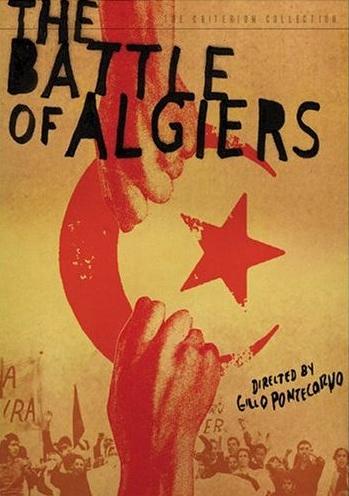
The Battle of Algiers (1966)

The mishmash of production values cobbled together to form the riveting political docudrama The Battle of Algiers is fitting in that it suggests the film itself is a product of revolution. Observing with equal intensity and human regard the opposing sides involved in the revolution against the French occupation of Algiers (officially known as the Algerian War of Independence) from 1954 to 1962, the film takes an objective look at the nature of terrorism and revolution amidst the social and political chaos in this modern world. A slight sympathy is lent to the Algerian rebels - appropriate in the light that the French occupation was truly an act of oppressive imperialism - but even then the film doesn’t shy away from the callous moral implications put forth by rebels ordered to plant bombs amidst crowded public locations (the documentary-like approach reaches it's most tense and gripping during these scenes of impending death). Both sides exchange various forms of violence in a continuing cycle: guerilla strikes and attacks against French officers lead to more aggressive safety measures that further oppress the people’s culture and religion. With neither side showing any sign of giving up, the bodies continue to mount on both sides, many of them innocent civilians willingly sacrificed as violent leverage in the name of war. Perhaps most illuminating is how The Battle of Algiers looks at the goings-on of revolution on both an all-encompassing and microcosmic level; as critical as a successful worker’s strike against the government is to the movement's influence, the actions of many individuals are just as crucial to the life blood of the resistance. With every attack and demonstration recreated with gritty realism, the film is a telling capsule on the nature of humanity within the constraints of political mire; one cannot watch without recognizing the parallels with the current U.S. occupation of Iraq and the ongoing struggle between the stationed troops and a minority of displeased insurgents. For those who feel that current situation is a fruitless effort to spread democracy to other regions of the world, one only need look at this film for proof of history’s tendency to repeat itself.

eXistenZ (1999)

A debate has raged for some time within internet circles of film and video games lovers since Roger Ebert stated, prompted by the adaptation of the classic first person shooter Doom, that video games are not art (with that movie being the subject for analysis, who can blame him?). My own personal stance is that video games are a blossoming art form, capable of such deeper emotional and intellectual capacities but little more than suave technical exercises at this point in time. Should the type of gaming depicted in David Cronenberg’s eXistenZ ever come to pass, however, I think Ebert will gladly modify his stated opinion. Much like the neck-based ports used by the protagonists in The Matrix, the characters in eXistenZ hook up to their gaming units (themselves a sort of living organism, made from animal parts and organs) via spinally linked bio-ports, connecting them to the software directly through their nervous system. Experienced gamers should find much to savor through the film’s unique assessments on the nature of reality (interwoven with loving nods to video game clichés), complicated by a multi-layered plot that posits a famous software designer against radicals who want to put an end to her existentially-redefining technological labors of love. eXistenZ is viscerally and philosophically titillating in same the way that makes all of Cronenberg’s films both physically challenging and intellectually satisfying (here, in particular the sexual connotations suggested by the characters’ biological modifications), although the script isn’t willing to go nearly as far in probing the material as Cronenberg takes it with his striking visual flair. That flaw limits the film from its greater potentials, but Cronenberg certainly makes the most of the film’s intriguing opportunities.

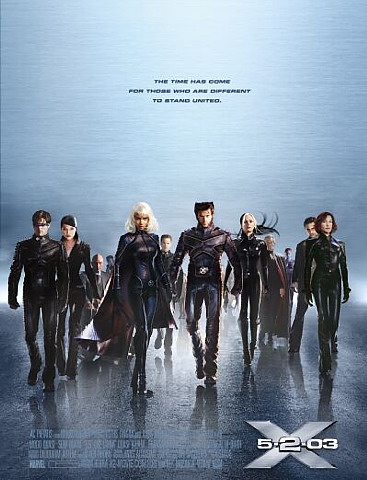
X2 (2003)

While nowhere nearly as satisfying as Sam Raimi’s pristine Spider-Man 2 (or even Christopher Nolan’s Batman Begins), the focus on character relationships and driving motivations is the key to Bryan Singer’s X2 being lifted above the marks of the average superhero sequel. More viscerally engaging than the laborious (and not very good) original X-Men, this part dues sees the previously opposing sides of outcast mutants (feared by society for their unique powers) joining together against an anti-mutant government official who aims to eradicate their kind from the planet. With Professor Charles Xavier (Patrick Stewart) aiming to integrate humans and mutants in peaceful fashion and holocaust-survivor Magneto (Ian McKellen) working to separate the two races completely, the film suggests a social war waged between Martin Luther King, Jr. and a pre-enlightenment Malcolm X, although the current battle for gay rights acts as a more fitting modern comparison for “the mutant problem,” as is stated in the film. The multitude of characters is almost too much baggage for the film to handle in it’s two-hour running time, although it does come very close to managing them all with equal regard and depth (particularly the cigar-chomping Wolverine’s existential pangs, finely played by Hugh Jackman). X2 might be a bit too ho-hum for it’s own good in the end, but it’s earnest entertainment and acknowledgement of the audience’s capacity for intellectual and emotional involvement sets it well above the majority of summer’s typical popcorn fodder.

Monday, May 29, 2006

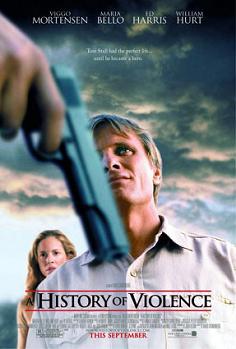
A History of Violence (2005)

Life in a rural American town is almost too good to be true in David Cronenberg's A History of Violence, which posits the glossy sheen of its close-knit community against the personal and familial tribulations brought about by the undoing of a false identity maintained by one of its residents. Behind the purported behaviors and attitudes of both townsfolk and family members lie unexpressed feelings and hidden truths, whether they're actually conscious of it or not. While the film doesn't quite suggest that the American dream on display is all image and no substance, it makes it perfectly clear that all is not what it seems.

Take, for instance, Tom Stall (Viggo Mortensen), loving husband, father of two, and esteemed business owner in his hometown of Millbrook, Indiana. When a pair of nomadic thugs hold up his diner one evening and threaten the lives of he and his customers, Tom's responsiveness, which finds both criminals dead by gunshot, is both deft and instinctive. Tom's skill with a firearm earns him the status of a local hero, an unfortunate fact when mobsters from Philadelphia show up at his diner and home, prompted by Tom's newfound popularity in the media. They know him as Joey Cusack, member of the Philadelphia mafia until he disappeared in the midst of bloodshed, changed his identity and set up a new life over a decade ago. Quickly, the structural basis for the life of both Tom and his family erodes away.

The malleable nature of identity is the life blood of A History of Violence, but the shock waves that register after Tom's past is revealed are the most compelling of its elements. Deceptively, the film's first act establishes the happiness of Tom's current life, only to be subjected to an existential schism when the past catches up with him. "I thought I killed Joey," pleads a torn Tom to Edie (Maria Bello), his distraught wife, upon his inability to maintain his guise any longer. The man she loves so deeply is still the same person, but her perception of him requires a complete overhaul, causing her to be simultaneously attracted to and repulsed by the muddled persona that happens to be her husband (most prominently displayed in a scene of spontaneous marital sex, at once loving, carnal and harboring intense resentment). We have no reason to question Tom's love for his family or the purity of his motives for starting his life over, but a responsibility for his past remains nonetheless, if only because who his is now is inseparable from who he once was.

Cronenberg's attentiveness to composition should come as no surprise, but that makes the film's visual reflection of its moods and relationships no less noteworthy. Everyday structures - a counter, a table, a curtain - act as signifiers of emotional disconnect, while the loaded shotgun in the Stall family living room, hastily removed from the closet, represents the uncovering of the past in response to present trauma. Meanwhile, paralleling more overly political cinematic dissertations on violence from this past year (Munich, Paradise Now), Tom is forced to tap into his otherwise repressed violent instincts in order to himself survive as well as to preserve the safety of his family, a trait handed down to his bullied son in typical ancestral fashion. Once out in the open, however, it doesn't take long for that same violence to turn inward, which is were the film's sense of ongoing struggle, long after the credits are over, finds its most potent outlet.

A History of Violence's rigorously intimate framing - positioning individuals as if we're only allowed to see what they choose to show - would be next to worthless without the affecting nature of its many complex, excellent performances. Maria Bello is the most immediately recognizable as a stricken and confused wife, devolved from someone without an ounce of concern as to the stability of her surroundings. Mortensen, on the other hand, has been unfairly overlooked for his skills; his performance is less boldly stated, but that's also because his character is in effect an actor as well, the multiple layers of his persona evident in his uneasy efforts at maintaining his behavioral camouflage, counteracted by his instinctive reactions to danger that betray his better efforts. In a final act appearance (so brief it just misses qualification as a cameo), John Hurt is perhaps provides what is perhaps the film's most savory performance, creating a wonderful character performance that makes this viewer wish an offshoot sequel were made for his persona alone.

Despite being named in the title, the violence in the film is less important thematically than it is as a means of disarming the audience with its horrific realism; shot through the back of his head, one of the would-be criminals at Tom's diner lies in a pool of his own blood, his jaw mangled, still half-conscious. By refusing to diminish the visual impressions Tom's actions leave, the film simultaneously removes the violence's typical quality of providing visceral entertainment as well as underscoring the scars that violence can leave on a family and community, whether through their occurrence in the present or their presence in history. While not as emotionally wrenching as, say, The Fly, the film continues to showcase Cronenberg's masterful knack for showing us those aspects of ourselves towards which we bear a natural aversion to. Through its restrained observation, A History of Violence peels away the layers we see daily to find the haunting truths concealed beneath.

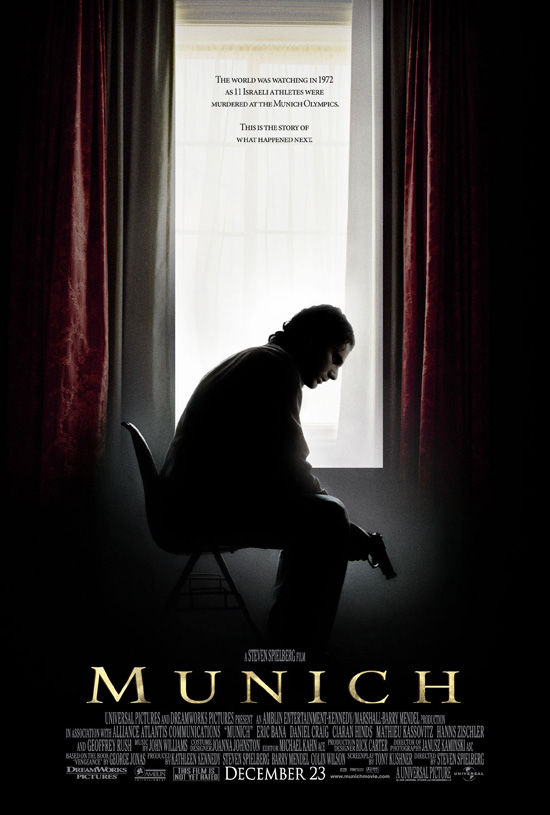
Munich (2005)

A plethora of names – the cities to host the Olympic Games prior to 1972 – fill the screen in the opening frames of Munich. This textual myriad soon fades to black to reveal the film’s title, bathed in crimson red, followed by the disclaimer, “inspired by true events.” This moment emphasizes the weight of the tragedy to take place at the supposed festivity of world peace, as well as the necessary declaration that this is art, not history. The Olympics spanning the globe, however, also suggests that Munich's story is one deeply universal in nature. The hosting cities standing in for a sampling of the entire world, Munich emerges as but one of many similar stories throughout human history that, in the end, are really about the same thing. As regards history, the film is an examination of the nature of humanity, in this case, the darker aspects of violence, revenge, and death, rather than a regurgitated depiction of events passed. Some may disagree with Spielberg’s politics as expressed in Munich, but if there’s one thing the film certainly is not, it’s simple.

A longing for home is the central core to Spielberg’s powerful dissertation. The real-world conflict between Israel and anti-Semite Arabs provides the film’s dramatic backbone from which it can occasionally deviate, so it may look closer at the gritty humanity behind the events that unfold, for both the good and the bad. One side claims the need for a home after thousands of years of persecution, the other the home they once had, pulled out from under their feet. Both sides suffer casualties from the other, and both sides see fit to reprise the latest attack from their enemy. As Spielberg expresses through one of his characters: “There is no peace at the end of this.” But to protect oneself and ones family, violence is sometimes needed, whether as a means of protection, or dissuasion. But under what circumstances, and in what quantities? In the midst of asking these very difficult questions, Munich declares family and home as that which it is most allegiant to (even if, like a good dissenting citizen, it questions Israeli policy). To quote but one of many memorable statements from Spielberg's dialogue: “A place on Earth. At last, we have a place on Earth.”

After a team of eleven Palestinian terrorists take nine Israeli athletes hostage at the 1972 Munich Olympic Games, ultimately killing them all before the eyes of the world, the Israeli Prime Minister Golda Meir (Lynn Cohen) knows that any act of reciprocation will only see more violence against their people. Yet to remain mute in the face of such a media-frantic tragedy would be to show a face of weakness. “Forget peace for now. We have to show them we’re strong.” Enter Avner (Eric Bana), an ex-soldier, Israeli-born Jew asked to lead a five-man mission to assassinate the eleven terrorists (members of the group Black September) behind the Munich massacre. He accepts the job, even with a seven-month pregnant wife waiting for him in Jerusalem. One by one, they hunt down and kill the individuals responsible for the massacre, even being well aware that those killed will have even more ruthless replacements. The pertinence of this timely issue is no coincidence, especially when one regards the simple visual statement in the final scene of the film. Can a war on terrorism be won? Or will the need eventual for non-violent dialogue be lost on those in conflict, even as the effects of vengeance become counter-productive?

In addition to deconstructing the taken-for-granted perceptions of violence and revenge, Munich also finds itself a disarming take on the relationship between the viewer and the film in it’s depiction of the assassinations to follow. Filmed with the skill of a master, they are riveting and enthralling, even as we’re horrified by man’s inhumanity to man in all its aspects. In one poignant scene, like the calm before a storm, Avner talks friendly with a Palestinian terrorist on a hotel balcony. The film declares no moral ambiguity between the “sides” shown at war, but acknowledges that even one’s enemy is almost always still human. When Avner’s team finds themselves occupying the same building as their future enemies (after an unexpected meeting and nerve-racking cease-fire), the discussions, both verbal and wordless, are illuminating. The most memorable of these is a quarrel over the radio station of choice; Steve and an equally stubborn Palestinian take turns changing the dial to their particular preference, back and forth, encapsulating the cyclical tendencies of exchanged violence and thus, their potential for sheer pointlessness.

The progression of violence and killings serve as the source of desensitization for the Israeli team members. Unsure of the reliability of his sources and employers (one of whom may be backed by the CIA), and in the midst of the deaths of several of his fellows, Avner’s once sturdy faith in Israel wanes in the face of fear for his and his families' safety. Avner loves Israel, but learns that blind allegiance to authority can just as readily cause death as it can prolong life. Amongst the fellow missionaries, the audience can gauge the spectrum of thoughts and feelings that exist on these shaky grounds. Steve (Daniel Craig – if this is film is any indication, a worthy addition to the Bond franchise) sees no worthwhile humanity in the enemies the film makes room to humanize: “The only blood that matters to me is Jewish blood.” Carl (Ciarán Hinds) seeks to retain his sanity in the midst of the bloodshed, where one’s humanity can naturally erode. Bomb maker Robert (Mathieu Kassovitz) questions how true to their ideals their actions are: “We are supposed to be righteous! I lose that, that's my soul.” In shifting between moments of quiet thought and thrilling moments of visceral terror, Munich examines not only the relationship between the thought and the act, but between what is right and what is necessary. Evil is subjective here, the film wading deep in the murky grays of morality.

Many will be, and indeed, already have bee enraged by the political dialogue presented in Spielberg’s film. Many of these are only so because the film allows doubt to enter the equation of thoughts, and even though the film feels a deep love for Israel, that hasn’t stopped many Jewish scholars from practically expelling Spielberg from the community. Munich is the bravest film of Spielberg’s career, perhaps one of the bravest works of thoughtful art of all time. His choice to expose himself for criticism as the cost of getting these issues more into the open – and therefore more into the realm of thoughtful discourse – is brilliantly reflected in a sequence later in the film. Robert (who closely resembles a younger Spielberg – this is no coincidence), stricken with depression from his duties for Israel, takes leave to his cottage home to rest and recuperate. There, he tinkers with his bombs and gadgets, handling them, examining them, and deconstructing them (in essence, learning how these dangerous objects work). Not long after, one of them detonates (foreshadowed as a possible suicide, but never confirmed; hopefully the DVD commentary will clear this up). In short: Spielberg knows that he’ll ultimately touch off a nerve and take a lot of shit for doing so, but these topics and questions must be raised in the open if an answer is ever to be reached. The effect of controversy is often the mark of great art, and Munich finds a thinker, a filmmaker and a Jew offering up a work of personal introspection and anguish that’s says much about the world and the many peoples who occupy it. At the relatively moderate risk of some flack, it hopes to make it a better place.


North Country (2005)

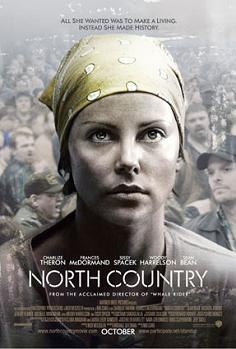
Few things are more dramatically heinous than depicting complex and far-reaching social problems with such single-minded intensity so as to reduce the effect to pure propaganda. When a film depicts its events as occupying reality rather than commenting on it, the use of such broad generalizations and black and white us vs. them distinctions (while perhaps making things palatable for the cinematically retarded) renders any potentially valid points mute when one looks beyond the Lifetime cartoon antics at hand and out into the real world. In tackling the issue of gender relations and sexual abuse in a male-dominant workplace, North Country sees fit to define its characters almost exclusively by their status as either victim or victimizer (subtleties only allowed for weepy melodramatics – ladies and sensitive guys, get your tissues ready!). Charlize Theron’s Josey Aimes gets a job at the local mine to support her two children after leaving her abusive husband (enter the disapproving father and supportive mother for contrasting dramatic effect). There, the handful of female employees must endure the taunts and come-ons from the horny male populace on a daily basis in order to bring home the bacon. Bearing the mind-numbingly overused “based on a true story” label, North Country takes excessive dramatic liberties with the story of the real Lois Jensen and her class action lawsuit against the mining company; excessive not because adherence to fact is mandatory, but because the film ultimately lauds its “inspirational” appeal more than it’s half-assed examination of the turgid social and sexual climate it pillages for tears and applause from the audience. In the end, it’s all about “standing up,” while the utterly ridiculous build-up to the truncated conclusion may as well play out in a boxing ring. Director Niki Caro exquisitely examined female empowerment amidst oppressive cultural conditions in her wonderful Whale Rider; on the other hand, North Country condescends to its audience and reduces its characters to LCD-levels of complexity, negating the seriousness it feebly reaches for in the process. Josey ultimately triumphs, but only because her past experiences somehow validate her present battles as a freedom fighter, and, whaddya know, her nice male lawyer is accused of being gay at the local bar (so we know he's okay)! These are deep social plagues that demand serious thought and attention, yet North Country would have you believe it’s no more complex than a playground quarrel between boys, girls, and cooties.

The Squid and the Whale (2005)

Familial dysfunction is the accepted norm in Noam Baumbach’s semi-autobiographical The Squid and the Whale. While that element gives the film a tinge of reminiscent nostalgia even as the conflicts at hand wage mental and emotional distraught in all directions, the knowing overtone that being fucked up is pretty much the norm also gives the film the freedom to suggest a wholly realistic opportunity for something better to come out of the present chaos. “Joint custody blows” becomes the unofficial motto for offspring Walt (Jesse Eisenberg) and Frank (Owen Cline) when their parents Bernard (Jeff Daniels) and Joan (Laura Linney) separate in 1986 after eighteen years of marriage and almost half a decade of hidden turmoil. Walt and Frank (“chicken” and “pickle,” respectively) take allegiances with their father and mother (also respectively), and both the natural destruction of the family unit as well as overtones of selfishness and greed on their parents’ parts take their tolls on the impressionable youth. The titular metaphor stands in both for the aggressive negotiations often seen in a family as well as a reflection of the uneasy sexual maturation of both the pubescent Frank (who exhibits common Freudian obsessions) and the older Walt (whose navigations in the world of dating are not unlike that of a mine field). When Walt claims Pink Floyd’s “Hey You” as his own work in a school talent show, the fact that his disguised cry for help goes almost completely unheard makes his struggles even more poignant. The Squid and the Whale features perhaps the best ensemble cast of any film from 2005, the standout here being Jeff Daniels in a career-high, incredibly nuanced performance that brings great humanity to a largely unpleasant persona. The largely handheld camerawork compliments the natural aesthetic, aiding the film to capture reality rather than simulate it in this reflective and provoking slice of often tarnished but absolutely real life, a reminder that both trials and pain can be as beautiful an experience as any other.

Howl's Moving Castle (2005)

Unlike the mythological Princess Mononoke or the fantastic childhood nostalgia of Spirited Away, Howl’s Moving Castle is a Miyazaki film that seems content to meander from one location and idea to the next with less in the way of tangible coherence than deeply satisfying emotional curiosity. This fact might limit it from reaching the same pinnacles as those two previous films, but for all its losses, the film gains a sense of visual wonder almost completely freed from the strains of a narrative-driven film. In a way, the titular vehicle, a massive plethora of rooms, stacks and chunks that lumbers from place to place on spindly legs (all the while swelling and bending in manners that seem wonderfully contradictory to the laws of physics), is representative of the entire film. Much of it may lack in explanation or logic, but the presence of it all it is a wonder to behold.

Howl is but one of many wizards and witches in this fantastical land, one whom is known through rumors for his ruthless behavior toward beautiful woman, but in fact shows suave kindness to the young Sophie in a chance encounter. Later, after Sophie unknowingly offends the evil Witch of the Waste and is promptly transformed into a ninety-year-old woman (the curse works double fold in that she is unable to talk to anyone about it), she seeks out Howl and takes on the job of his cleaning lady, hoping to eventually be cured of her condition. Howl’s reckless use of his magical powers is reaching new levels of potential danger to himself and others, all at the same time the countryside is at war (the ambiguity and implied corruption of which suggests a passive commentary on world politics), a mess which Sophie and her newfound company quickly find themselves in the midst of.

Miyazaki’s knack for offbeat supporting characters is as evident here as ever: a silent, always helpful scarecrow (dubbed ‘turnip head’ for obvious reasons), a fire demon named Calcifer, forced by Howl through a spell to power the castle, and the usual motley of contrasting human characters make up the diverse cast. Even when the story seems about to burst at the seams, the depth and nuance of the characters keeps the proceedings both relevant and affecting, as the various visual motifs, character relations and metaphysical implications are often hazy and seemingly inconsistent, even to the most seasoned Miyazaki fans. In the English-dubbed version, Billy Crystal is a constant hoot as Calcifer, although the voice actors in the original version (unseen by me) are said to be more in character. The visuals, however, an economic combination of traditional hand-drawn cell animation with computer-generated scenery, are the most aesthetically satisfying element of the film one way or another; the soulless CG spectacles from DreamWorks and Disney can’t even begin to hold a candle.

12 Angry Men (1957)

A young Spanish boy, raised in the slums, stands on trial for the murder of his father. Twelve white jurors march off to decide his fate, most of them convinced of his guilt purely on the basis of his appearance and background before facts have a chance to even enter the equation. These opening scenes of 12 Angry Men, first written in 1954 and filmed here in 1957, are exceedingly telling about the racial and economic divides in America even with fifty years of hindsight. While the film most prominently prescribes to the importance of upholding one’s democratic responsibilities as well as one’s obligation to their fellow man, the racial divides that separate the haves from the have nots is another roadblock that has refused to go away, and thus remains a hot topic suggested here. An average 90’s remake of the film hardly had to change a thing to bring the material up to the times, suggesting that as long as democracy exists and we human participants are flawed in nature, 12 Angry Men and the issues it raises will be timeless in nature.

Taking place almost entirely within the jury room, 12 Angry Man watches as eleven jurors first convinced of the suspect’s guilt are slowly won over to the side of reasonable doubt by the one man sympathetic enough to at least look over the details of the case before sending a man off to die. The twelve men (referred to by their juror number rather than name, as goes the democratic process) exist less as individual characters than as semi-exaggerated caricatures that siphon variously opposing, often clashing viewpoints. For as nicely packaged as 12 Angry Men often is, it makes no self-saluting greater aspirations (I’m talking to you, Crash), which gives the material the much-desired breathing room it needs to reach full potency. As the most ardent believers of the suspect’s guilt refuse to be worn away by the evidence mounting up in favor of his innocence, one might sense that they exist largely as straw men for the film’s levelheaded bleeding heart to tear down. That would be the case were such stubbornness and bigotry not present in the real world, and if 12 Angry Men’s jury room acts as an unstated microcosm of the real world (or at least American society), then it’s allegorical implications hit all the right notes, even if they may be somewhat oversimplified in the long run.

I seriously doubt that the triumph of truth-seeking over reckless abuse of democratic power portrayed here is what generally unfolds in the real world; for as much as 12 Angry Men reflects the many divides of society, it also exists as an idealistic vision of what democracy should be. As a political lesson, it earns the right to borderline on preachy, but as a drama, the film arguably works even better. Employing tighter framing compositions and lower-level angles as the film progresses, the sense of tension and heightened tempers in the small room escalates to near unbearable levels, punctuated by newfound inconsistencies in the testimonials as well as revelations that cast known details of the case in a new lighting. Such images as eleven of the jurors standing opposite the irrationally enraged juror number three (Lee J. Cobb) evoke a wonderful sense of humanities’ potential for good, political context notwithstanding. But as a work that reflects on the common regard for one’s fellow man as expressed through the Constitutional right to a fair trial, it is also a pertinent and demonstrative film. In other words, somebody put 12 Angry Men on George W. Bush’s Netflix queue.

The King of Kings (1927)

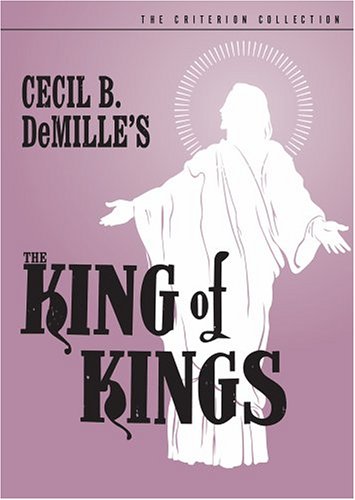
Even seen theatrically and accompanied by a live organ performance (as I was priveledged to do so during a restoration run), Cecil B. DeMille's silent would-be epic The King of Kings is a tedious, strictly standard affair, revealing itself as a precursor to Mel Gibson's Christian propaganda piece The Passion of the Christ, albeit without the gore or bloodshed. Originally released as an opener to new theater houses, the film exists primarily to enlighten audiences as to the divine nature of the Christian messiah. In actually showing his godly capabilities as well as why he bore such a threat to the Roman leaders of the day, King of Kings outdoes The Passion in terms of actually providing some meaning for the ultimate crucifixion. But while this work is far from a snuff film, it's sampling of stock character conflicts and overt self-importance renders it little more than a dead-in-the-water melodrama from the days of past.

The first glimpse of Christ (H.B. Warner) is presented via the restored sight of a blind child, positing the audience as both the healed and enlightened. DeMille's overly literally imagery finds little restraint here, both in the grand, elaborate sets and costumes as well as the camera tricks showcasing events of religious and supernatural grandeur. With a bit of narrative liberty taken from the gospel sources, the film's Jesus extricates Mary Magdalene's sins from her soul one by one in a scene completely unaware of its outright silliness. Likewise, the climactic end to the crucifixion sees fire and brimstone rain down upon the unbelievers in an earthquake-like disaster in perhaps the only scene that registers to some tangible effect, even if it feels completely removed from the rest of the film. Ultimately, the exaggerated chaos of it all suggests that those still unconvinced as to whether or not the path of Jesus is the right one have another thing coming, and had better reconsider their status.

Holy its source materials may be in some circles, The King of Kings finds no such divinity in its uninspired biblical retellings, where the good and evil in its characters are worn prominently on their sleeves. Jesus' wise and perfect portrayal is suiting, but from his first glimpse on screen there's never any doubt as to the role Judas (Joseph Schildkraut) will play, rendering his ultimate betrayal completely meaningless. With such reliance on such thinly developed protagonist-antagonist antics, the film never reaches the sense of greater importance it pronounces so boldly. When Christ ascends to heaven three days after his death, the effect is not one of great meaning or accomplishment, but redundancy. Using title cards lifted from scripture, the film is a preachy affair from the very outset, its greater intentions suffocated by it's unwillingness to let the audience appreciate the finer qualities of its message without them being overblown in presentation. Sermons rarely make good films, and this one is no different.

Paradise Now (2005)

Sure to piss off conservatives and nationalists aplenty (if you don't believe me, just skirt on over to the imdb boards), Paradise Now continues the recent trend of politically-minded films in its examination of the social, cultural, religious and personal roots of terrorism: that which motivates its perpetrators to carry out their heinous crimes. The conflict in question is that between the estranged Palestinians and the Jewish state of Israel, and made from the perspective of the former, the film certainly lends its sympathies to those people forced to live on the outskirts of their former civilization. However, one won't find any overt criticisms or justifications of either pro or anti-Israel ideals here, but an examination that concentrates more on the humanistic effects of said conflict than which side is ultimately in the right or wrong.

Said (Kais Nashef) and Khaled (Ali Suliman) are the potential suicide bombers in question, two long-time best friends living amidst a stateless people removed from their former homeland. The hatred for Israel is strong, and expressed potently: "If we cannot be equal in life, then we can surely be equal in death." When recruited for the anti-Israeli operation, they're reminded of the eternal glory reserved for them for their actions. Even so, both have deep personal investment in their cause. In portraying these two as individuals capable of love, fear, doubt, etc, the film surely qualifies as one that humanizes terrorists, making the important (and oft-overlooked) point that those who commit evil deeds often do so for thwarted reasons, and that evil is rarely a form that exists only in a social vacuum. To examine their causes while still condemning the violent outcomes is a tricky path to walk, and Paradise Now straddles the slippery slopes expertly from start to finish, assuming the audience in question first gets around the tepid nature of the subject matter.

Any intellectual squeamishness brought about by Paradise Now is more than likely caused by viewers who take their ideas and beliefs regarding the material for granted, rather than anything in the film that could actually be considered offensive. With its in-depth look at the process leading up to the terrorist acts regularly made callous by the media, the film asks numerous important questions (most important in my mind: should the sins of one people fall on the shoulders of later generations?), and in becoming an expertly constructed thriller in the process, challenges the audience to examine their own perceptions of violence in a very tangible and intimate manner. Incidentally enough, Paradise Now is an excellent companion piece with Steven Spielberg's superior but equally challenging Munich, a film that poses many of the same ideas and questions, but from an opposing perspective in the same scenario. If these films can teach us anything, it's that there are never two sides to any conflict: there are always far, far more.

Memoirs of a Geisha (2005)

Japanese culture is ransacked and pillaged much like a whorish sideshow in the searingly bad Memoirs of a Geisha. If a live-action culmination of every culturally tasteless Disney movie from the past fifteen years (Aladdin, Pocahontas, Mulan) were ever to come into existence, this is it. Sure, the film looks good, and it’s three technical Oscars were all somewhat deserved. But strip away all the pretty colors and sets, and you have a story about as truly meaningful as the kitschy feel-good paragraphs on the back of any given cereal box. The flimsy she-loves-him, he-loves-her-not, he-loves her storyline that propels this series of unfortunate events from start to finish could exist, with minor tweaking, in any place and at any time; the pretty Japanese colors and lights are but window dressings. Of course, how many people in the intended audience would know that, or would even care in the first place?

Oh, to reminisce of the days of being a geisha! Since when was being a high-class whore so nostalgic? Since razzle-dazzle director Robert Marshall got his hands on the material, for starters. His Chicago was utterly soulless, but so were it’s convicted female protagonists. Memoirs of a Geisha, on the other hand, yearns for a heart and spirit, but fancy art direction and flashy cinematography will have to suffice while the screenwriters get a clue. The flimsy characters only pander to Marshall's reductive direction: villainous characters here could easily be mistaken for their intentionally satirized equivalents in the parody film Kung Fu Hustle. In keeping with the film’s pandering to western audiences, the less romantic aspects of the geisha lifestyle are largely ignored, while those that are acknowledged are reduced to the irritating squabbling of drunk sorority girls. I’m less ready to deride the casting of Chinese actresses in Japanese roles; hell, Al Pacino pulled off playing Tony Montana, and the real essence of acting lies in playing a person that you are not. However, the choice to make the film not in its native Japanese tongue, but badly broken English, takes what would have already been a shallow storyline and reduces it to the kind of atrociously bad camp that even SNL can’t pull off anymore.

When the film isn’t spreading bad eastern stereotypes via it’s Japanese actress playing American perceptions of Chinese actresses, it concerns itself with the story of Chiyo (Suzuka Ohgo as a child, Ziyi Zhang as an adult), a young girl sold as a child to the geisha house. After quickly overcoming her familial losses, she accepts her new lifestyle and yearns to become one of the prestigious geishas. This is so she may capture the heart of a man, an esteemed chairman (Ken Watanabe), with whom she instantly falls in love with during an early encounter in her new environment. Where the film falls short (read: crashes and burns violently) is in it’s refusal and inability to concern itself with the emotional and psychological aspects of its story, reducing these elements to badly deconstructed dialogue and soap opera plotting; this way, the visual aesthetics can take center stage. Indeed, this is less of a film than a theatrical circus act, with Japanese culture as the freakshow on display for American audiences to lap up. What we have here is world culture filtered through a tasteless lens that doesn’t want to understand or observe, but only to gawk and pillage. If this kind of abhorrent cinematic imperialism plays out as it usually does, chances are we’ll see “Memoirs of a Geisha: On Ice” within the very near future.

Wolf Creek (2005)

Wolf Creek emphasizes the harshly unforgiving elements of the Australia outback as a prelude to the physical and psychological terror to ultimately be experienced by it’s ordinary protagonists, three easygoing twenty-somethings who set out on a road trip across the uncivilized desolation. Eerie compositions posit the small gang and their bought-for-cheap car against the vastness of the environment, and we sense that, should the forces of nature decide to turn against them, they wouldn’t stand a chance. Employing burnt-out color hues and an uneasy focus on natural imagery, Wolf Creek tilts its perception of the outback so that even the most typical of landscapes seem positively alien in nature. In a way, Wolf Creek stands as a companion piece with the less effective Open Water; both films concern small groups of people who are subject to terror and death when their accepted social safety nettings suddenly fall away. Whereas the doomed couple in 2003’s indie hit were at the mercy of the forces of nature (in the form of sharks), the trio of Wolf Creek are instead subjected to pure human evil in one of it’s most horrific cinematic realizations.

Roughly divided into two acts, Wolf Creek spends the first half finely establishing characters and relationships while the gritty textures of it’s murky high-definition cinematography slowly wear away the nerves of the viewer. The acting here is so good you won’t even see it (often leading to people mistaking it for bad acting), the rough-and-tumble realism of it all instilling the difficult-to-achieve notion that these are genuine people. These three souls, Liz (Cassandra Magrath), Kristy (Ketie Morassi) and Ben (Nathan Phillips) set out on their road trip through the outback where, as early title cards inform us rather blandly, thousands of people are reported missing every year. Following these individuals in their brief travels allows us to see their personas by means of their simple interactions, making it all the more devastating when the safety of their lives is unexpectedly shattered.

Once the trio reaches the titular location (a giant meteorite crater in the outback), all plans and even semblances of sanity begin their downward spiral. After their car mysteriously stops working, help offered by a local is all but impossible to refuse. Rough around the edges but seemingly friendly enough, Mick (John Jarratt) tows the trio to his camp, an abandoned mining area in the outback. A nighttime conversation around a campfire is deeply unsettling, but even the stranger aspects of Mick’s attitude don’t ring the proper warning bells for the victims-to-be. When morning comes, they’ve all been bound, gagged, and separated; neither they nor the audience knows how, making their newfound situation all the more surprising and horrific.

What follows is a harrowing witness to the evil capabilities of a completely amoral being: Mick may as well be a fellow animal of the outback, impartial to any sense of reasoning or human emotion. Unlike trademark horror villains Jason and Freddy Kreuger, Mick is able to pass off as a normal human being, thus heightening his capabilities as a human Venus flytrap. The terror meted out on Liz, Kristy and Ben is like the most viscous game of cat and mouse ever played, both physically excruciating and psychologically tormenting (with the twist of a knife, the film contains perhaps the single most disturbing moment in any film from at least the past five years). Like Tobe Hooper’s The Texas Chainsaw Massacre before it, the acts carried out on the innocent are savage, unforgiving, and often the result of simply being in the wrong place at the wrong time. That anyone survives in either film hardly allows for a happy ending; when all is said and done, Wolf Creek’s conclusion feels like little more than an afterthought.

The violence in Wolf Creek isn’t nearly as extreme as many have made it out to be, but the absolute realism of its context, both in presentation as well as the tangibility of the characters it is bestowed upon, makes it all the more forceful. Some, such as Roger Ebert, have suggested that it exceeds the acceptable level of seriously depicted violence in film, although these criticisms are within the context that bearing witness to such violence is meant to be entertaining. Such is hardly the case with such a primal slab of terror, testament to the evil that exists in the world, although not everyone is going to see it that way. Some sick audiences even get kicks from this sort of graphic torture (one woman at the screening I attended complained about the lack of deaths – within the first fifteen minutes), a fact that only reinforces the misanthropy that always rests just below the surface of my generally cynical mind.

Where such gleeful indulgence in death the attitude of this film, I’d readily join Ebert’s ranks, but even while portraying the events at hand, Wolf Creek never loses it’s deeply humane sympathy for the victims, despite baseless accusations of misogynistic overtones. In a post-9/11 society, it’s reassuring to see a horror film genuinely grappling with the violence and evil that so surely exists in our world (and always has – Americans were just better sheltered until recently), refusing to tone down the events experienced by it’s characters for the sake of a potentially squeamish audience. Anyone who finds this entertaining is surely desensitized, and should seek professional help (if they aren’t already beyond it), but for those who can stomach the visceral terror unleashed upon these three individuals, Wolf Creek is deeply unsettling in a profoundly existential manner.

Spider (2002)

Spider refers to both the main character's nickname and the thematic essence of David Cronenberg's feature, in which the camera functions as a psychological signifier, reflecting and amplifying the twisted mental state of its subject. By means of deceptively simple visual signifiers, compositions, and camera movements, Spider creates a smooth, angular perception of the world not unlike the finely woven web of a spider itself. This puzzle-like rhythm finds physical manifestation in at least two scenes in the film; it is from these many fractured yet interconnected pieces that the viewer, like Spider himself, must find meaning in and ultimately put their sense of reality back together.

Unlike the sickeningly literal and overwrought direction of A Beautiful Mind, Spider feels from start to finish as if all hangs by a thread. This is appropriate, considering that David 'Spider' Cleg has just been released to a halfway house from his stay at the insane asylum. We immediately sense that all has not been well for Mr. Cleg for some time, but now, even more so, seemingly everyday experiences and objects trigger locked-away memories and anxieties, forcing Spider to revisit his past in ways both literal and psychological. The connection between the traumas of the past and the events of the present are achieved through simple directorial touches and unheralded, effects-less walks down memory lane, in which Spider watches his past unfold in the presence of his parents and 9-year-old self (think of Harry Potter's trips through the Pensieve without all the fancy visual flourishes). These scenes embellish the roots of his frightened tendencies and discomfort with the female gender with understated efficiency. Fearing his father's abusive behavior towards his mother, young Spider withdraws into a world driven by a variation on the Oedipal complex. However, it isn't long before what has been accepted as reality reveals itself as an unexpected "yellow wallpaper" scenario.

Silently fractured and presented, it is these many pieces of the narrative that make up the confusing world of Mr. Cleg, although attention is all that is needed to put them back together as they slowly reveal themselves. Silent yet progressive, Spider subjects the viewer to the unfolding events as both an outside observer as well as through Spider's own perceptions. If A Beautiful Mind plays its psychological fantasies as a dramatic thrill ride before the ultimate plot-twisting pivot point, then Spider immerses the viewer in a state of tragic limitation before the revealing, tragic conclusion. These revelations serve to unify the audience and Spider, both drawing upon the same knowledge and both experiencing the same enlightenment simultaneously. Sharing this quality, Spider proves the antithesis to Ron Howard's Oscar-winner, nursing the emotional connection between the viewer and Spider rather than jerking them around like a flimsy dramatic roller coaster.

Cronenberg's films are known for their tendency to instill discomfort in the viewer by means of their intent look at those aspects of human nature we'd generally prefer to turn a blind eye to. Spider, in it's meditations on perception and insanity, satisfies this definition, but differs from the bulk of his works by means of its incredibly minimalist construction (as well as a noticeable lack of "squishy body" elements, a la Jeff Goldblum's physical transformation in The Fly). While Cronenberg's direction keeps the aesthetic respectful and sympathetic towards Spider's state (unlike Ron Howard, who prefers to capitalize on these disorders for cheap dramatic tricks), it is ultimately Ralph Fiennes' wonderful performance that creates the film's emotional backbone, which runs through like an invisible current. Spider is both ugly and off-putting, but bears a child-like innocence that makes his plight all the more sorrowful, lining the film with a sense of redemptive optimism amidst the predominant misanthropy. Incredibly rewarding and deeply humane, Spider may not be Cronenberg's best film, however, its contrasting tones and style proves his status as a master even when working outside his usual realm.

The Chronicles of Narnia: The Lion, the Witch, and the Wardrobe (2005)

The slightness that permeates The Chronicles of Narnia must surely have been exacerbated in my mind by the far more encompassing vision of an alternative world present in the recent Lord of the Rings films, but even without such a superior example in mind, the gawking superficiality present here still strangles any potential feeling out of the proceedings. The problem seems to exist from a purely creative standpoint, being that, in the making of this film, there was none. Direction isn't a word that seems to apply to the shooting and editing of scenes in this film: a computer could have done this job with equal efficiency. However, whereas commercially slick films can often be exceptionally entertaining even without an auteurist signature on them, The Chronicles of Narnia does not fall into that category. Unconcerned about those unfamiliar with the source material, the film takes the easy route by aiming directly at those already converted to the works of C.S. Lewis (close friend of "Lord of the Rings" author J.R.R. Tolkein, who disapproved of Lewis' overt Christian symbolism), much in the same way Chris Columbus' Harry Potter films blandly adapted their respective books.

The story of four siblings (refugees from a World War II-torn London) who stumble upon a hidden world through the porthole provided by a magical wardrobe is ripe with beat-you-over-the-head religious allegory. That, however, is the least of its problems, even if it's moralizing often spills over into outright treacle. Amidst this new world of animals, humanoid beings and great warriors, there isn't even a table scrap of a narrative dedicated to the basic tasks of developing characters or establish relationships (in other words: anyone without previous introduction will be unlikely to care about them or their plight on anything more than a superficial level); instead relying upon bogus sibling conflicts in its lame efforts to connect with the audience. This isn't a cinematic adaptation: it's a celluloid Xerox of the novel so readers of Lewis can see their favorite moments on the big screen in a greatest hits package.

In Narnia, the battle between good and evil lies just on the horizon, and only the four human protagonists (referred to as sons of Adam and daughters of Eve) can ensure that the former will triumph over the latter, led by the evil White Witch (Tilda Swinton). Forget why such good vs. evil labels are dealt out, for morality here is defined only by how cute and fluffy the beings in question are. For as many characters as there are populating the film, the amount of attention given to raising them above the level of mouth pieces for the plot and limp allegory is stark at best. Meanwhile, the conflict at hand isn't the only thing that's sanitized here: every scenic composition and visual set piece is so blandly orchestrated that not only is any sense of wonder undercut by the plainness of it all, but the only thing that comes to mind is how much better it's all been done before, many times over. With six more novels to go in the original catalog, let's hope they start getting it right with Prince Caspian.

Edward Scissorhands (1990)

Johnny Depp's sympathetic performance as the asocial recluse Edward Scissorhands is so unique and heartfelt that, above all else, he deserves a better movie to star in. Tim Burton's works, even more so in his early films, are characterized by exaggerated characters and expressionistic imagery; here, the obtuse and haunting castle in which Edward resides contrasts the prim-and-proper caricature of the suburban American dream. The inventive visuals and overwrought characters are the best things about Edward Scissorhands, which strives to be the kind of dark fantasy that carves out an otherworldly niche for itself to explore new feelings and emotions that otherwise would be inaccessible in a typical representation of reality. But Edward Scissorhands is forced to adhere to a reminiscent and ultimately uninspired plot, one that siphons off half the wonder the film otherwise manages to achieve. This kind of creativity employed for the sake of routine tedium is not only an artistic injustice, but it results in the kind of movie in which anger arises from the lack of a better screenplay.

Like Frankenstein before him, Edward was made from scratch by an inventor (although not necessarily the mad scientist type here), leaving him without family or any others of his kind in whom to find company or solace. The inventor died before he could finish his creation, leaving Edward not with hands, but unwieldy scissors meant only to be temporary tools. When a well-meaning resident of the town below happens upon Edward's castle during her rounds to sell Avon products, she discovers the lonely figure and brings him home with her. Community gossip ensues, and while Edward's existential plight proves useful when his skills find their proper outlets, it isn't long before the greedy townsfolk take advantage of his abilities and hapless social skills. An understated connection develops between Edward and the young Kim (Winona Ryder) (in a dash of Beauty and the Beast), who seeks to shield him from the misunderstandings of the world.

Edward himself is one of the great creations of modern film, like a leftover gothic relic from the silent era. His early efforts at conforming to typical societal standards are both tragic and endearing: he cannot begin to put on regular clothing without tearing the garments to shreds, and the easily overseen image of him precariously balancing a pea on his scissor blades (during a desperate attempt to eat dinner without the means of traditional silverware) brings to mind the simple plights of Chaplin's tramp in it's simple humor. Unfortunately, whereas Edward represents Burton's creativity at its peak, the storyline screams out for more creativity and substance. Unlike Burton's own Big Fish (arguably the director's most accomplished film), which was truly emotional in it's own right, Edward Scissorhands' efforts at emotional affection are poorly manipulative and reliant upon hollow tactics that, in the end, are simply going through the motions without drawing from anything deeper within.

Some of Edward Scissorhands' flaws are relative (actresses as young as Winona Ryder should never be forced to play elderly versions of themselves), but the indulgences in blatant logical gaps that serve only to perpetuate Edward's status as a social outcast are beyond forgiveness. Edward's persecution is tragic in all the right ways, and a cunning commentary on both human nature and, in this context, American culture, but it's continuation relies on tactics most writers should learn to avoid by the time they've passed their Screenwriting 101 course. Whenever Edward Scissorhands stands on the brink of becoming truly magical, it truncates itself into settling for less. That Tim Burton has appropriately used his own unique zeal in many other films doesn't make Edward Scissorhands feel any less like a lost opportunity.

Sunday, May 28, 2006

Crash (2005)

Crash instills its audience with proclaimed enlightenment beneath the deception of its compulsively watchable aesthetic. Paul Haggis' film is nothing if not well intended, but that fact only further solidifies the film as perhaps the most misguided socially aware film to hit theaters since the dawn of the new millennium. L.A. serves as the cultural stand-in for this hyperlink drama that focuses on racism and prejudice in this modern world. A multitude of characters from different backgrounds act as Haggis' puppets in a show that highlights, bolds, and emphasizes with an exclamation point the presence of these behaviors and their destructive ways, which would be all well and good were it not for a keen feeling of contrivance running throughout the proceedings. Amidst attempts at wrenching drama caused by these blinding forces throughout the film's interwoven plot lines, Crash hopes to illuminate enough so as to find some better good within humanity and society.

With its multitude of characters, Crash spreads the racism cards all around, looking at black prejudice against whites, whites against blacks, racial and religious discrimination, and everything of similar ilk. Quickly, the film's structure becomes fairly obvious: all these individuals have both good and bad sides, and are both victims and perpetrators of racism. The film strays, however, by refusing to take things to the next level, instead shifting into overdrive its intended appeal for the tear ducts. The film's parable-like structure is betrayed by a conclusion that refuses to charge the audience with the crushing weight of the issues being observed (instead opting for a ridiculously upbeat and morally inappropriate closer), thus demoting their importance in the name of feel-good schmaltz (to Steven Spielberg: for War of the Worlds' final five minutes, you are forgiven), and as a commentary on real-world racism, the film is too tidy and fantastical in nature to be genuinely representative. In the end, instead of commenting about racial discriminations or distinctions in a meaningful manner, the film puts all the cards on the table and throws its hands up in an act of confusion, as if that's the answer.

Few of Crash's individual moments are as troubling as the entire whole. In fact, the film - which features a number of very good performances (sadly used to such shaky ends) - starts off well enough. A meditative opening credits sequence uses a montage of out-of-focus, nighttime highway shots to emphasize a blurring of societal expectations. The low, pulsing soundtrack behind these images could be described as the collective heartbeat of the human race. If only Haggis were able to probe these thoughts and feelings and relay what he finds to the audience with any kind of subtlety or craft. Rather, as soon as the film opens its mouth, any potential quickly begins to drain away. Don Cheadle's policeman Graham, having just been involved in a minor car accident, explains the meaning of the film's title in a dunderhead monologue: “I think we miss that touch so much, that we crash into each other, just so we can feel something.” Like a good joke, a great metaphor is rendered worthless if you explain it outright.

The realities of the world are similarly exaggerated and simplified for the sake of the assumedly oblivious audience. The silent malice of racism and prejudice are naively converted into explanatory social lessons (before hijacking an SUV, Ludacris and his partner pontificate about prejudice against blacks, as if hosting an academic lecture on the topic) that prove to be not only condescending, but dangerous in the extremity of their representations, which fail to acknowledge the more subtle and common ways in which these forces go to work in the world. Haggis' efforts at shaping society are admirable but must be recognized for their shortsightedness and misrepresentation, as well as the genuinely irresponsible pandering the film does to the very same audience it should be charging with the grave importance of these matters. Were the film less intent upon unnecessarily placating the viewer, the immediacy of its cause might register as more than fodder for an undercooked soap opera.

Friday, May 26, 2006

Maintenance Work

Below you will see the primitive version of the Alphabetical Review Archive that will serve as this site's index - look to the right for a permanent, convenient link that can be accessed at all times. All films reviewed will be listed and linked there, even if they are only addressed in capsule reviews composed into larger posts (in other words, you may have to scroll down a bit to get to the movie you clicked on). For now, just skim over it's presence on the blog main page. Also, in the very near future, expect a surge of new reviews posted, the majority of them previously published on older web sites constructed by yours truly.

Alphabetical Review Archive

12 Angry Men
25th Hour

Aguirre: The Wrath of God
Army of Darkness
Army of Shadows
Assault on Precinct 13 (1976)

Balseros
Basic Instinct
Battle of Algiers, The
Beautiful Mind, A
Birth of a Nation, The
Black Dahlia, The
Blob, The (1958)
Blob, The (1988)
Boyz N the Hood
Breaking the Waves
Break-Up, The
Bride of Frankenstein

Cabinet of Dr. Caligari, The
Cannibal Holocaust
Cantor's Tale, A [Slant Magazine]
Chronicles of Narnia: The Lion, the Witch, and the Wardrobe, The
Clerks II [The Stranger Song]
Covenant, The
[Slant Magazine]
Crash (2005)
Crimson Gold

Da Vinci Code, The
Dead Ringers

Departed, The
Descent, The
Dogville
Dracula (1931)

Edward Scissorhands
eXistenZ

Fargo

Flags of Our Fathers [The Stranger Song]
Fly, The (1986)
Frankenstein (1910)
Frankenstein (1931)
Freaks
Fury

Gojira (Godzilla) (1954)
Guardian, The [Slant Magazine]

History of Violence, A
Howl's Moving Castle

I Am a Fugitive From a Chain Gang
Ice Age: The Meltdown
In the Mood for Love
Inconvenient Truth, An [The Stranger Song]
Inside Man

Kekexili: Mountain Patrol
King of Kings, The (1927)

Lake House, The
L'enfant (The Child)
Lenny

Malcolm X
Manderlay
Marie Antoinette [The Stranger Song]
Marine, The [Slant Magazine]
Memoirs of a Geisha
Miami Vice
Mission: Impossible III
Munich
Mummy, The (1932)

Napoleon Dynamite
Neil Young: Heart of Gold
Night of the Living Dead
North Country
Nosferatu (1922)

Office Space
Out of Place: Memories of Edward Said [Slant Magazine]

Paradise Now
Passion of the Christ, The
Phantom of the Opera, The (1925)
Pirates of the Caribbean: Dead Man's Chest
Prairie Home Companion, A

Running Scared

Santa Clause 3: The Escape Clause, The [Slant Magazine]
Sarah Silverman: Jesus is Magic
Sin City
Snakes on a Plane [The Stranger Song]
Spider
Squid and the Whale, The
Star Wars: Episode I - The Phantom Menace
Star Wars: Episode II - Attack of the Clones
Star Wars: Episode III - Revenge of the Sith
Superman
Superman Returns
Sweet Land [Slant Magazine]

Talladega Nights: The Ballad of Ricky Bobby

Terrorist, The
Tremors

United 93 [#1]
United 93 [#2]
Usual Suspects, The


V for Vendetta
Vampyr

Wah-Wah
White Zombie
Wicker Man, The (1973)
Wolf Creek
Wolf Man, The
World According to Sesame Street, The [Slant Magazine]
World Trade Center

X2

X-Men: The Last Stand


Zoom [Slant Magazine]


Army of Darkness (1993)

With the reluctant hero Ash (Bruce Campbell) having been unwillingly sent from his haunted cabin in the woods back to medieval times, the opportunities for camp indulgence in Army of Darkness have been considerably expanded upon from those in the first two Evil Dead films. Looser than the overdrawn original film but not as tight or relentlessly original as the second, this capper to Raimi’s schlock horror trilogy is wicked fun in delightfully bad taste, the visual gags coming fast and cheap as Ash disposes of any possessed creatures that unwisely crosses his path with prowess and brio to spare. Here, the zombies take a backseat to a skeletal army that wages war against the local castle residents, led by a chainsaw and shotgun wielding Ash (“You see this? This is my boom stick”). The feel is fittingly haphazard, moving from one outrageous visual gag set piece to the next without a moment more of screen time dedicated to the necessitated plot than is absolutely necessary. Perhaps no moment of the film is funnier (at least to knowing film geeks, a la Robert Wise’s The Day the Earth Stood Still) than when Ash, commanded to retrieve a sacred book that can return him to his own time, tries to cover up his failure to remember the magic words needed to do so with perfectly timed ineptitude. With loving references to the legends of King Arthur, Gulliver’s Travels and The Three Stooges abound, Army of Darkness succeeds thanks to its indulgences into the utterly ridiculous.

Rating Guide Archive

Departed, The
Frankenstein (1931)
Gojira (Godzilla) (1954)
Howl's Moving Castle

I Am a Fugitive From a Chain Gang
Kekexili: Mountain Patrol
Lake House, The
Manderlay
Office Space
Paradise Now
Terrorist, The
Tremors
Wolf Man, The
World According to Sesame Street, The [Slant Magazine]


Army of Darkness
Black Dahlia, The
Blob, The (1988)
Boyz N the Hood

Cantor's Tale, A [Slant Magazine]
Descent, The
eXistenZ
Lenny
Malcolm X
Out of Place: Memories of Edward Said [Slant Magazine]
Sarah Silverman: Jesus is Magic
Snakes on a Plane [The Stranger Song]
Star Wars: Episode II - Attack of the Clones
Star Wars: Episode III - Revenge of the Sith
Superman Returns
Sweet Land [Slant Magazine]
Talladega Nights: The Ballad of Ricky Bobby
White Zombie
World Trade Center
X2


Beautiful Mind, A
Break-Up, The
Crash (2005)
Dracula (1931)
Edward Scissorhands
King of Kings, The (1927)
Mummy, The (1932)
Passion of the Christ, The
Phantom of the Opera, The (1925)
Pirates of the Caribbean: Dead Man's Chest
Superman (1978)
United 93
Wah-Wah


Basic Instinct
Chronicles of Narnia: The Lion, the Witch, and the Wardrobe, The
Clerks II [The Stranger Song]
Da Vinci Code, The

2006 Catch-Up

One of my goals on this blog is to provide documentation and critical response to everything I watch (including repeated viewings, which are often more crucial to one’s relationship to the film than the initial). Sometimes they will be in the form of full-length reviews (which I try to make at least three paragraphs in length), sometimes shorter capsule commentaries, and sometimes in stub form. The tides will shift depending both on what movies are in question and what else is going on in my life at the time. Here now is a quick gathering of comments on this year’s films that I have seen so far (the small number of which is telling of the general quality of early-year releases) and as of yet been unable to address. Enjoy!

L'enfant (The Child) (2006): B+

Never before has a film’s understated realism been so powerful as to elicit tears from me during the very first scene. Such is the case with L’enfant, a film with such clear perspective into it’s characters that it takes on a Godly presence around them, we the audience being the detached onlookers who withdraw and revel at their failures and triumphs. The simple story of two young parents well out of their arena in regards to the responsibility of caring for a newborn child, the film serves to examine their conflicting moralities and attempts to rebuild that which has been broken between them. Key to the film is the realization that the title refers not to the infant child but to the immature father, whose personal ordeals are emotionally draining yet subtly revelatory.

Inside Man (2006): B

Spike Lee’s first full-fledged mainstream film is no Do the Right Thing or 25th Hour (my own personal favorite joint), but it’s savory entertainment qualities and complimentary racial and social commentaries (largely reflecting a post-9/11 social paranoia in New York) make it both smart and suave. Denzel Washington and the star-studded cast all engage the plotting (which concerns a hostage-complicated bank robbery that unknowingly digs into deeper issues than how much money is in the safe) with substantial brio, but it is the grizzled Clive Owen who truly leaves his mark. Roll me another.

Mission: Impossible III (2006): C+

Tom Cruise’s ego has generally remained off screen and in the public media domain during his career, and that fact is what allows the third installment of this franchise to be a mostly-inoffensive piece of superfluous entertainment rather than anything outright insulting. New love interest, new gadgets, new locations and new deadlines that, if not met, bear deadly consequences. What makes this film stand out from the previous two Mission: Impossibles is Phillip Seymour Hoffman’s presence, who creates a villain (particularly in the film’s electrifying opener, a flash-forward teaser that starts the film off on a level it never again matches) so intense and menacing that, had he been allotted more screen time, might have bourn comparison to Sir Anthony Hopkins’ Hannibal Lector. Nonetheless, the shoot-outs and chases are competent, the pacing taught, and the end result mildly digestible cinematic fluff. Save the hate for Michael Bay’s next flick.

V for Vendetta (2006): D+

This wannabe dystopian political commentary, despite featuring a climactic scene of Parliament being blown up by a faux-terrorist/revolutionary figure, is a stuffy affair of pretentious, fanboy-appealing twaddle and cowardly allegories. 2020 London is under the totalitarian rule of a government responsible for unspeakable crimes against its citizens; reporter Evey Hammond (Natalie Portman) is drawn into the workings of a cloaked and masked figure known only by the pseudonym V (a well-acted Hugo Weaving) who seeks to overthrow the corrupt regime with the help of the countries oppressed people. Commentaries on current U.S. politics are overt and poorly drawn, what with the mawkish romanticizing of oppressed homosexuals and minorities, and the fascist, Newspeak-dribbling Chancellor (John Hurt) bearing no small likeness to George W. Bush. As a sympathizer to the film’s ideologies, it pangs me to see such potent ideas reduced to cartoonish portrayals of good and evil and left and right, especially because there is no doubt in my mind that a brilliant film could be made from the original graphic novel by David Lloyd (who has officially disowned this movie). As a political work, V for Vendetta is too reductive and oversimplified to be seriously thought provoking, and as a genre film, it’s pacing, action and even visual compositions are too dullard and uninspired to be enthralling. Still, I will be surprised if a better movie poster is created for any film this year.

Ice Age: The Meltdown (2006)

In making the same fatal error as do about 50% of all sequels of the past five years (in that they take the concentrated elements that made their predecessors so popular and amp them up to unbearable quantities, all the while forgetting the basic storytelling elements that made them successful in the first place), Ice Age: The Meltdown may as well be called Ice Age: Reloaded. The original film was slight and mostly uninspired, but it had one key element going for it: memorable characters with unique personalities. Amongst these were two stand-outs: Scrat, a prehistoric squirrel / rat critter with a recurring existential dilemma in the form of an ever-elusive acorn, and Sith, a lisp bearing sloth who, thanks to the vocal talent of John Lequizamo, could hardly open his mouth without uttering a hoot-worthy one-liner (and simultaneously putting Eddie Murphy’s obnoxious Donkey to shame).

Losing the dullard human element from the first film, The Meltdown sees the original motley crew in the same unfortunate position as the rest of the animal population. The ice that has existed for thousands of years is melting, and high grounds must be reached quickly if anyone is to survive the rising waters. With this handy road-movie plot in hand, the film launches new characters and meandering conflicts into the mix to pass the time in lieu of any real story or substance to be had. Sith doesn’t get enough respect, Manny (Ray Romano) might be the last of his species, and Diego (Dennis Leary), the sabertooth tiger, is afraid of water. These newfound obstacles are not only thematically pointless (in that they disappear only because the plot demands them to at key points, rather than any tangible character or story development), but are laced with the kind of hipster humor marked with a five-minute expiration date once their shallow pop culture references fade from the public spotlight.

I don’t know who’s more irritating amongst the new characters: the possum brothers voiced by Seann William Scott and Josh Peck, or the mammoth (who thinks she’s a possum) voiced by an overenthusiastic Queen Latifah (somebody get me out of here). Amidst all the cheap visual gags and unnecessary musical numbers is a giant narrative vacancy occupied by a plot that even straight-to-video features tend to rise above. For as endearing as Scrat’s antics are, even they can’t sustain the lackluster jokes that pass for humor for the bulk of the ninety-minute running time. If there were any creative justice in this world, the effort put into Ice Age: The Meltdown (as well as the mandatory future sequels) would instead be channeled into a series of cartoon shorts featuring Scrat alone (who is, truthfully, the only reason anyone sees these damn things). They could be aired before various children’s and family films, and would later be compiled into a DVD collection. That, of course, would be the right thing to do (indicated most tellingly by the fact that this film's teaser trailer was composed entirely of the film's funniest two minutes). But that route wouldn’t bring in a $60 million opening weekend, would it?

Thursday, May 25, 2006

A Beautiful Mind (2001)

Perhaps it’s only from having the inanity of The Da Vinci Code and lameness of Cinderella Man for retrospective comparison purposes, but revisiting A Beautiful Mind since it’s Oscar victory indicates the film, however undeserving a victor it remains, is a more fitting example of overly-touted mediocrity than outright garbage. The story of John Nash, the brilliant (and anti-social) mathematician who had to overcome schizophrenia (a psychological disorder which induces apparitions of nonexistent people and events) before ultimately winning a Nobel prize for his work, is given the lavish and all too typical Hollywood bio-drama treatment, complete with swelling score and a climactic standing ovation, signaling that the hero in question has overcome whatever obstacles the plot laid before him during the previous two hours. However, despite its un-ironic adherence to so many obtuse and dramatically stagnant conventions of the genre, half of A Beautiful Mind actually comes close to being a very good film. Whenever the focus remains on the relationship between Nash and his wife Alicia (the always elegant Jennifer Connelly), the film approaches a quiet honesty towards its characters as well as something the rest of Howard’s catalogue cries out for dearly: subtlety. On the flipside, the creatively empty presentation of Nash’s psychological disorder ruins any greater potential with both its absurdity and character condescension. In presenting his personal traumas and ordeals, the film vies for the route of cheap visual tactics that serve almost entirely to keep the viewer in the dark until the big halfway-point twist, rather than providing any genuine insight into his experiences with the disorder – it’s the elusiveness of The Sixth Sense without the thematic parallels, and ultimately no more than exploitation of his condition for traditional entertainment purposes. To add insult to injury, Howard’s direction slips from competent to nonexistent whilst giving the viewer a peek inside Nash’s mental processes – digits, documents and words light up as if the subject of a PowerPoint presentation as he completes theorems and solves codes. It’s headache inducing enough that a bout of schizophrenia might be just the chaser one needs after being mentally throttled by 2001’s “Best Picture.”

United 93 (2006)

Before addressing the film in question, let me lay rest to the ridiculousness of these “too soon” accusations being lobbied against Paul Greengrass’ United 93. Not only do these sight-unseen naysayers seem to forget that 25th Hour and War of the Worlds ever happened, but the underlying assumption that films exist solely for entertainment purposes is outright condescending to the healing power of art. One only need look briefly at history to see how film, music, and the visual arts have always been used by society to come to terms with newfound developments and tragedies alike, and to suggest that a film like this comes “too soon” is to say that a culture should wait to rebuild after such a paralyzing experience. Whether for better or for worse, United 93 and any film of its ilk has every fundamental right to exist. Fear no art.

That being said, United 93 is only a partially successful rumination on the events that came to completely redefine what it meant to be a citizen of the United States (and, to a lesser extent, the global community). By focusing primarily on the events to unfold on Flight 93 – the fourth hijacked airplane that crashed in Pennsylvania before reaching its unknown target (outright named here as the White House) – the film is emotionally draining in a way words cannot describe. Surely, it would take a filmmaker of supreme incompetence to recreate these events in a manner that wasn’t harrowing and viscerally terrifying, especially for audiences who lived through much of the same experience less than half a decade ago. Shot entirely in hand-held cameras and presented as a pseudo-documentary, the films realistic nature has already earned it the label of a snuff film, but there is enough going on under the surface to negate the film’s great potential to be nothing more than hollow exploitation (the mind wanders to Pearl Harbor’s morally atrocious bomb point-of-view shot).

United 93 works best when it restricts itself to the doomed flight: the portrayals of both the hijackers and passengers are almost completely absent of characterization, freeing the film from standard genre conventions and allowing it to focus on the barest elements of humanity in conflict from an objective standpoint. By contextualizing these events via inter-cutting them with the destruction wrought on the World Trade Center, the film conflicts with its better intentions, as taking the focus off the conflict on board only lends the film to bullshit thriller tactics concerning events where there is no doubt as to what happened. Despite that fact, however, the tragedy that finally hits is less illuminating than it is outright pummeling, limited by an initial sense not of everyday routine to be shattered by unexpected horrors, but pre-eminent, unavoidable doom (mawkishly foreshadowed by passengers who seemingly talk about nothing but their kids at home, an unnecessarily lingering shot of the plane being fueled, etc.).

In a less artistically inhibited society, a film like United 93 would/should have been released no more than a year or two after the fact; with a full five years of hindsight, the film reflects the unfortunate fact that we have yet to really understand the fullest ramifications September 11th, 2001 has bourn upon American culture (no thanks to the senseless political mire that has come about after the fact). Despite its drawbacks and limitations, however, United 93 does fulfill enough of its obligations, even if only incidentally. The straight-faced recreation of events extinguishes the false foundations for the racist attitudes to have arisen since the attacks, as the hijackers look no different than their fellow, soon-to-be victimized passengers, whose uprising in an effort to regain control of the plane (and cause of it’s lethal descent) stands as a powerful testament to the power of the average person in the face of unspeakable horror. Perhaps no moment in the film is more telling than a sequence that contrasts both the terrorist hijackers and the hysterical passengers praying to God for strength and comfort. All in the name of religion.

Assault on Precinct 13 (1976)

The expectation-challenging role reversals of John Carpenter’s Assault on Precinct 13 are but one of the silver linings to be found in what is one of the most efficient and startlingly restrained action films ever made, serving as both full-bodied entertainment and unstated political and social allegory (comparisons with Romero’s Night of the Living Dead are certainly appropriate). The film’s technical attributes are so tightly executed that admiration of them threatens to cloud the thematically rich underpinnings, but for as socially aware as the film is, it never fails to supplant the proceedings with tense interjections of charged violence and to the point, balls-on humor (no moment is more pointedly hilarious than when an adrenaline-charged black prisoner of the titular precinct, under attack, declares his intentions of carrying out his own devised escape plan, “Save Ass.”).

Amidst youth gang riots by mindless rebels without a cause in a decrepit Los Angeles, one police station stands nearly deserted, it’s content and persons almost completely transferred to a newly erected location. Policeman Bishop (Austin Stoker) is assigned to baby-sit the station with the two remaining secretaries for the night, it’s electricity and phone lines to be turned off for good the following morning. A busload of prisoners en route to death row finds need to detour to the station when one of its occupants becomes violently ill. Meanwhile, a distraught father, having killed the gang member who senselessly shot his daughter, takes refuge from the armed on comers in the solitary Precinct 13, thus bringing down the wrath of the entire gang upon the building and it’s ill-equipped occupants. Ammo is low and, thanks to the enemies’ use of silencers, help doesn’t appear to be on the way anytime soon.

Aside from maximizing the film’s lean plotting with finely tuned characters and minute details, Carpenter further titillates his film by shaking up the standard genre conventions typically defined by various gender and racial portrayals. The fine line between the attacking gang members and defending Precinct occupants is one notably reflected as the superfluous boundaries between male and female, black and white, and even officer and prisoner fall away in the midst of the senseless killings. Assault on Precinct 13’s attention to character traits maximizes it’s subtle dissections of moral upholding and personal awareness of action; the righteous officer Bishop left the gang-oriented slums of his own will in his youth, while death-sentenced prisoner Napoleon Wilson (Darwin Joston) came to accept a violent lifestyle of his own accord. By remembering that every individual has the capacity to determine the moral course of their own lives regardless of what privileges (or lack thereof) they enter society with, the film remains smart, subtle and enthralling, it’s conflict allegorical of the civilized participants of society setting aside their differences to overcome the barbarous potential within every one of us.

Tuesday, May 23, 2006

Dead Ringers (1988)

Dead Ringers’ aesthetic is as cold and sterile as the polished steel of the bizarre surgical tools its main characters – brilliant gynecologist identical twins – use on their less “typical” female patients. Like much of the director’s body of work, the film approaches its material with a somewhat detached perspective, as if assuming the role of an impartial observer. In true Cronenberg form, it explores the darker corners of the human experience, and by withholding judgment on the extremely bizarre and potentially off-putting behaviors and events abound, it allows an insightful and weighty emotional resonance to accrue, often developing silently beneath the film’s surface and only striking the unwary viewer when the progressing events have them at their most vulnerable. Upon initial viewing, even I, a seasoned Cronenberg fan, was doubtful of the film’s potential at first. By the conclusion, I was nearly on my knees in anguish.

Forget Crash’s Best Picture victory (the racially themed Paul Haggis fantasy, not the 1996 Cronenberg feature of the same name) – that Jeremy Irons was passed over for at least a Best Actor nomination for this film lies near or at the top of the list of most major fuck-ups by the Academy. In almost certainly the role(s) of his career, he turns in two equally nuance-laden and emotionally complex performances as Beverly and Elliot Mantle, said twins who, while different enough to be distinguished by the knowing onlooker, appear to the majority of the outside world as one being. This often works to their advantage both professionally and personally; they sometimes routinely share the same lovers, and cover for each other in midst of various work-related dilemmas. Sharing becomes so commonplace between them that, when one slips into the grips of a drug addiction (an “occupational hazard” for a doctor), the other inadvertently does the same whilst trying to curb his brother’s destructive habits. Although separate, their beings are so closely intertwined that the escalating instability of their lives drives the potential for tragedy to unexpectedly dangerous heights.

Unlike the tour de force makeup work in The Fly, the special effects employed here are most effecting in that they remain completely unseen. Finalizing the hypnotic dual performance from Irons into a single and often seamlessly interactive whole, they complete the illusion that provides for Dead Ringers’ most basic emotional foundation (credit is also due to Howard Shore’s understated, moving score, which brings to mind a sculptor working his clay into form). However, beyond the physical obstacle of presenting the same actor in two places at the same time (long before the days of CGI wizardry, kids), the film’s most powerful elements are those that find Cronenberg again wrestling with the enduring questions of what it means to be human in the midst of lost humanity; the sensual indulgences that have come to define his work are complicated here by the suggestion that these two brothers truly share the same soul. The many biological implications will surely be more affecting (and potentially disturbing) to woman than men, but the genuinely earnest nature of the existential probing rids the film of any potential traces of exploitation. Dead Ringers’ cumulative effect is so deeply disturbing and troubling because of how intimate and personal a work it is; ultimately, the tragic beauty that lies at the end of the road for these tormented soul(s) is practically transcendent.

Sunday, May 21, 2006

The Da Vinci Code (2006)

The Da Vinci Code is what a close friend of mine refers to as a triple threat: bad director, bad screenwriter, bad book. Having not read Dan Brown’s best-selling “page turner” (practically a synonym for pedestrian trash), I cannot attest to the latter of those accusations, but mediocre is an apt descriptor for the first two categories. Assuming a mostly faithful interpretation of its source material, Akiva Goldsman’s screenplay fails to interject any narrative relevancy into the preachy, overly expository affair, which breaks down into an monotonous talk-run-talk affair as it’s heroes flee from one historical set piece to the next while pursued by misguided, however relentless, authority figures. As such, only the already initiated are likely to have much investment in what follows, if they can get over the lack of craft at hand. Director Ron Howard comes up empty like a failed magician: despite every fancy trick and stylistic touch he bombards his works with, the result is a pulseless excursion with minimal cinematic thrust that often borderlines on outright condescending with it's inane use of visual signifiers and artless attempts at dramatic significance.

Tom Hanks serves as The Da Vinci Code’s audience surrogate. Robert Langdon is a Harvard professor framed for a murder at the Louvre who, during the course of the film, alternately solves riddles and codes presented to him and stands lock-jawed whilst theories and little-known facts about the foundations of Christianity are explained in shallow detail. On the run with renegade cop Sophie Neveu (Audrey Tautou), the two follow a trail of clues and artifacts related to a series of recent murders as well as a massive religious cover-up that has been maintained and fought over for hundreds of years. Connection with the past and the importance of symbolic meaning are at the center of The Da Vinci Code’s plotting, but the essence of these cultural dialectics only serves to fuel the fact-lined fiction of the stories preposterous conspiracies rather than wax on any substantial emotional or theoretical connections with the subject matter. Had the film the energy to muster and ounce of reverence for faith-based actions or theological discussion, the ringers it puts standard Christian ideas through may have resonated with truth or even ideological stimulation. Rather, they serve only to further along a plot based almost entirely on constant twists and overplayed revelations. Kevin Smith’s religious satire and commentary Dogma bears more stimulation (it also remembers to be entertaining).

For all the historical location-hopping and money-shot sights, The Da Vinci Code never pulls itself out of its leaden narrative trench, remaining stagnant and dullard no matter how many crane shots and fancy CGI touches are injected into the midst. The solving of codes and riddles are accompanied by acknowledging flashes of the symbols in question, echoing A Beautiful Mind’s incredibly silly literalist visualizations of it’s characters thought processes. After a chin-stroking Tom Hanks fills in the obligatory "a-ha!" moments of the script, Ron Howard nails the coffin shut on his respect for the audience by highlighting the material in question for further emphasis, PowerPoint-style. Aside from pure inanity, The Da Vinci Code suffocates from a lack of invigoration, it’s self-important story reliant on shallow fact dropping and gimmick-laden visual compositions downright boring in their lack of imagination or originality. Of the cast, only Ian McKellen (who eagerly digs his teeth into the film’s campy potential) lights up the screen to any extent, while the remainder play the leaden material straight, underscoring the pretentious void beneath the film’s shamelessly exploitation manipulation. Despite zealous protests from the faithful against the film, it poses no substantial threat to religious establishment. Should it, then the Christian establishment would truly be an empty house of cards, for The Da Vinci Code's cumulative energy represents no more than a feeble puff of air.

Initiation Rites

So here I am once again, beginning anew. Amidst academic and work-related commitments, maintaining a website is too much for my schedules, and html too tedious an endeavor to motivate myself for after watching an invigorating film. My hopes are that a more user-friendly and formal blog will allow my thoughts to flow more freely and easily, rather than getting bogged down in trying to sound professional or overly articulate.

Here I hope to share all things film-related in my life, from that which I see to that which I try to give back to the community. Teaser: in two semester's time I shall be co-teaching a course at Moravian College in Bethlehem, Pennsylvania on the relationship between politics and film (expect appearances by Fritz Lang, Spike Lee and Sergei Eisenstein, among others). That and two other syllabi in the works are currently under my belt. Screenwriting will also take place this summer between myself and long-time friend and co-film lover Kyle Graper, a film major at Pittsburgh University.

The past has always seen me wrestling with my personal insights on film and approach to the aesthetic of film watching and criticism. If I've learned anything, it's that standards and attempts at formula are fruitless endeavors. Perfection is not an obtainable goal in the realm of the art, and lessons are often learned through mistakes and imperfections. Therefore, always expect this blog to be a work-in-progress, whether it is in the look or the content. I don't expect my ideas and insights to be exact or even consistent, and nor should they be. The title of this blog, "A Film Odyssey," functions two fold. Firstly, it pays homage to my absolute favorite film: my status as a cinephile was solidified at the age of twelve, when I sat wide-eyed in wonder at every minute of Kubrick's masterpiece as it aired in the early hours of the morning on TNT. Secondly, I view my own long-term relationship with film as something of an odyssey itself, a constant learning, building and waxing of appreciation, insight, skills and love. This blog will bear witness to just that.